



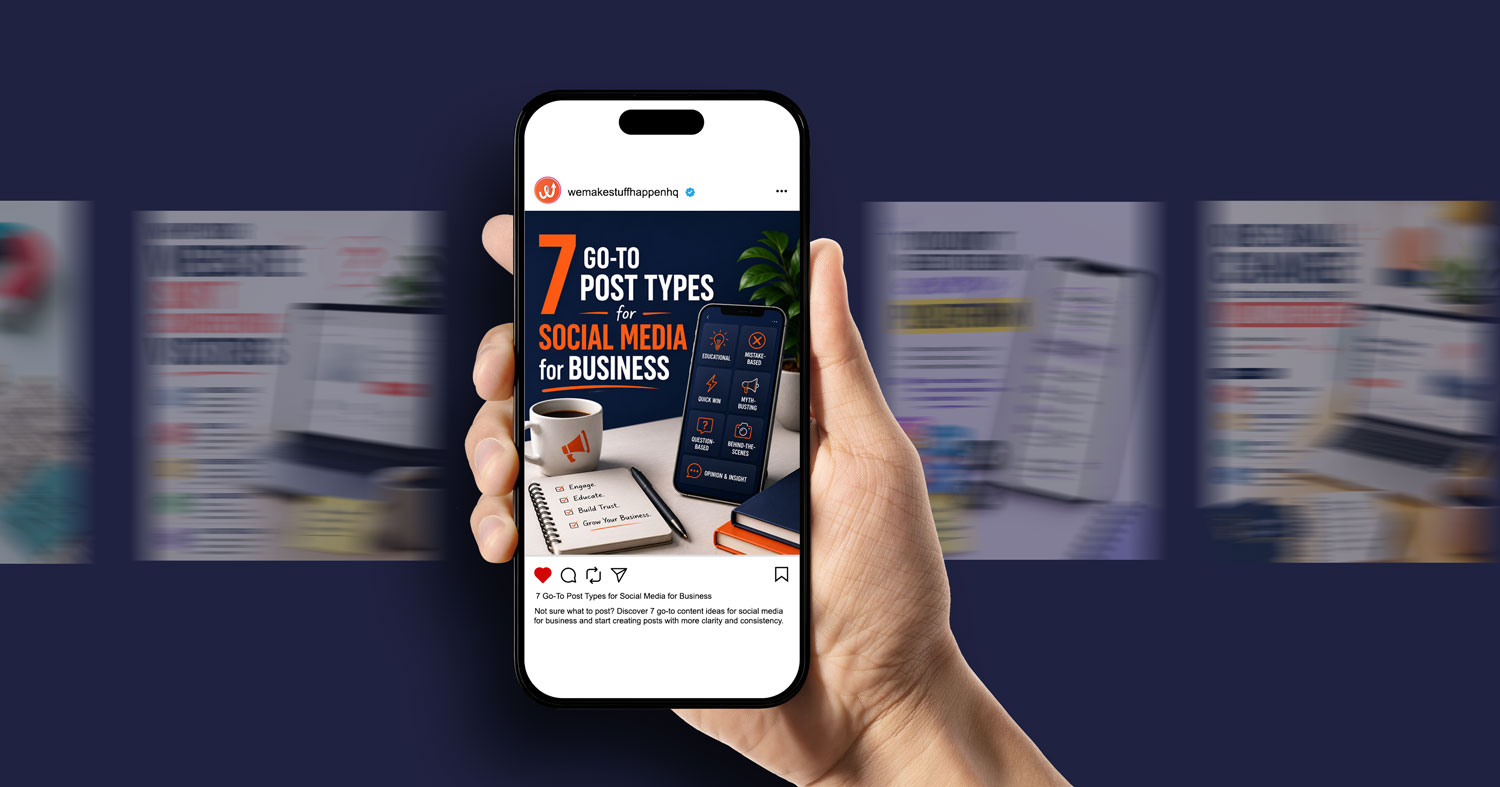
Why Social Media for Business Feels Like Guesswork
If you’ve ever opened Instagram, Facebook, or LinkedIn and thought, “What should I post today?” you’re not alone.
For many owners, social media for business feels like a constant guessing game. One day, you post something you think is helpful. The next day, you try something different. And after a while, it starts to feel like you’re just throwing content out there and hoping something sticks.
The problem isn’t effort; it’s direction.
Most businesses don’t struggle with showing up. They struggle with knowing what to say.
Instead of chasing trends or trying to be clever, let’s simplify social media for business into 7 go-to post types you can use again and again. No guesswork. No overwhelm. Just a clear starting point.
What Actually Makes a Post Worth Sharing?
Before we jump into what to post, it helps to understand why some content works and some doesn’t.
People don’t engage with posts because a business wants them to. They engage because something catches their attention and feels useful, interesting, or relevant.
In most cases, the decision to keep reading happens in a few seconds.
That means the success of social media for business often comes down to how clearly and quickly you communicate value.
If a post feels confusing, generic, or hard to understand, people scroll past it. Not because it’s bad, but because it didn’t connect fast enough.
That’s why structure matters.
When you know the types of posts that consistently resonate, social media for business becomes much easier to manage.
7 Go-To Post Types for Social Media for Business
Instead of trying to come up with something new every time, here are seven categories you can rotate through. Each one serves a purpose, and together they give you a simple system for social media for business.

1. Educational Posts
Educational posts teach your audience something useful.
These might include tips, how-to guidance, or quick explanations that help people solve a problem.
For example:
- “3 ways to improve your website conversions”
- “How to write a headline that gets more clicks”
This type of content works because it builds trust. You’re helping people understand something they didn’t before.
When done well, educational content becomes a strong foundation for social media for business because it positions you as someone who knows what they’re talking about.
2. Mistake-Based Posts
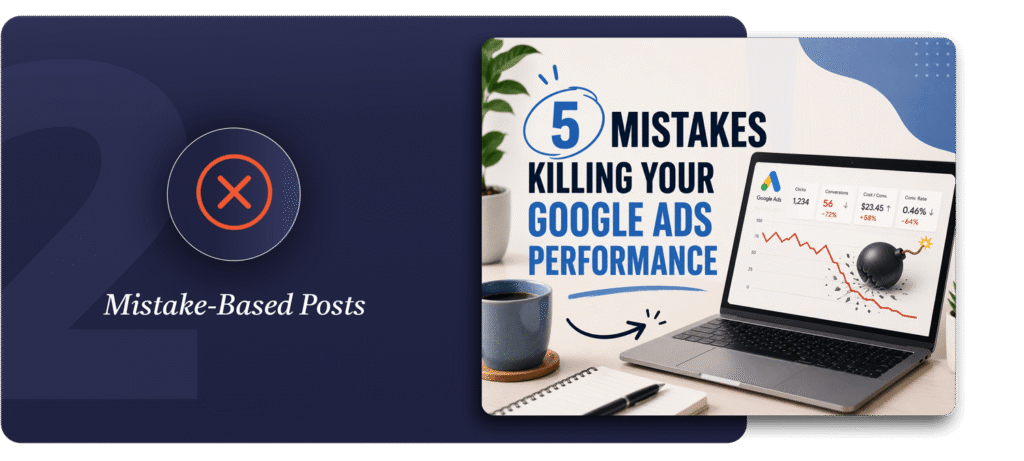
These posts focus on what people are doing wrong.
Instead of just sharing advice, you highlight common mistakes and explain how to avoid them.
Examples:
- “5 mistakes killing your Google Ads performance”
- “Why your website isn’t converting visitors”
This format works because people are often more motivated to avoid mistakes than to chase improvements.
It also makes social media more relatable. Readers see themselves in the problem and want to learn how to fix it.
3. Quick Win Posts
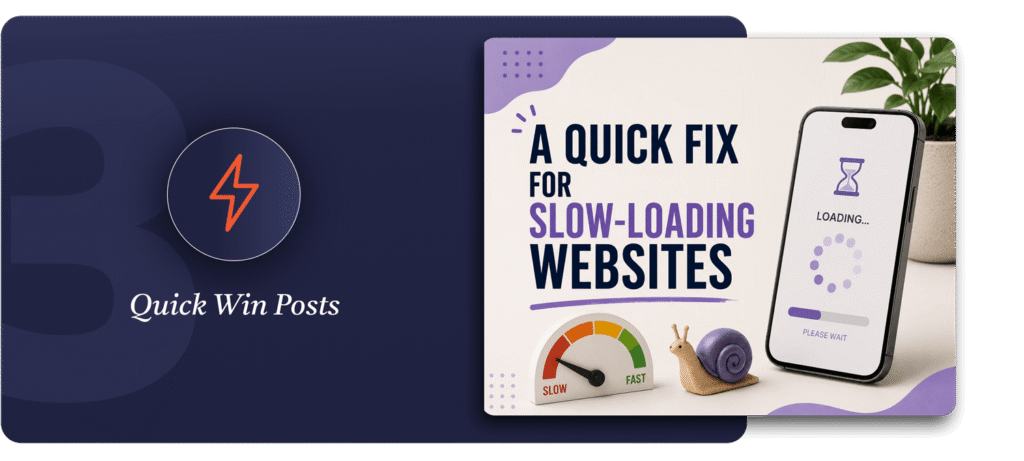
Quick wins are simple, practical tips that people can apply right away.
They don’t require a lot of time or effort, which makes them easy to act on.
Examples:
- “One small change that can improve your landing page”
- “A quick fix for slow-loading websites”
These posts are valuable because they give immediate results. And when people see small wins, they’re more likely to trust your guidance long term.
Quick wins are one of the easiest ways to build momentum with social media.

4. Myth-Busting Posts
Myth-busting posts challenge common beliefs.
You take a piece of advice that people hear all the time and explain why it’s not always true.
Examples:
- “Posting more content won’t fix your marketing problem”
- “You don’t need to be on every platform”
This type of content stands out because it breaks patterns. It makes people stop and think.
Used carefully, myth-busting can bring clarity to social media for business and help your audience focus on what actually matters.
5. Question-Based Posts
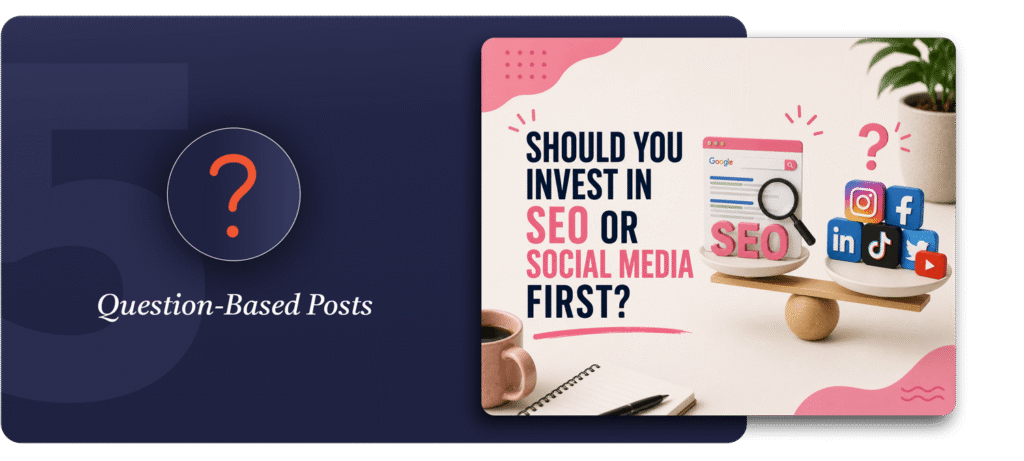
These posts are built around a question your audience is already asking.
Examples:
- “Should you invest in SEO or social media first?”
- “Is paid advertising worth it for small businesses?”
This format works because it mirrors how people think and search. It also makes your content feel more conversational.
For social media, question-based posts are powerful because they invite curiosity without requiring a hard sell.

6. Behind-the-Scenes Posts
Behind-the-scenes content shows how something works.
It might be your process, your workflow, or how you approach a project.
Examples:
- “Here’s how we plan a month of content in under an hour”
- “A look at how we build a high-converting website”
This type of post builds trust because it removes the mystery. It shows that there’s a process behind the results.
Even if you’re still refining your approach, sharing your process can make social media for business feel more real and less polished.

7. Opinion and Insight Posts
These posts share your perspective.
They’re based on your experience, observations, or what you’re seeing in your industry.
Examples:
- “Why most small businesses overcomplicate their marketing.”
- “What we’re noticing about AI and customer behavior.”
This type of content helps you stand out. It gives your brand a voice.
For social media for business, insight posts create connection because people follow perspectives, not just information.

How to Turn One Idea Into Multiple Posts
One of the biggest challenges with social media for business is the feeling that you always need new ideas.
But you don’t.
You just need to look at the same idea from different angles.
Let’s say your topic is preventing clogged drains.
You could create:
- An educational post explaining what causes most drain clogs
- A mistake-based post about what homeowners do that makes clogs worse
- A quick win about one simple way to keep drains clear
- A myth-busting post about whether store-bought drain cleaners actually work
- A question asking if it’s better to fix a clog yourself or call a professional
- A behind-the-scenes look at how you clear a clogged drain safely
- An opinion about why small plumbing issues turn into expensive repairs
That’s seven posts from one idea.
This is how social media for business becomes manageable.
You stop starting from scratch every time and start using a simple system.

Why Many Posts Still Don’t Connect
Even with the right post type, some content still gets ignored.
In most cases, it comes down to the hook.
The hook is the first line of your post. It’s what determines whether someone stops scrolling or keeps going.
If the hook doesn’t grab attention, the rest of your content doesn’t get seen.
This doesn’t mean your post isn’t valuable. It just means the value isn’t clear fast enough.
People move quickly on social media. They’re not reading every post. They’re scanning for something that stands out or feels relevant.
A strong hook makes a clear promise, creates curiosity, or calls out a specific problem.
For example, compare:
- “Here are some tips for improving your website”
- “The #1 reason your website isn’t converting”
Same topic. Very different result.
If you’ve ever struggled to come up with a good hook, download our 100 Scroll-Stopping Hooks for Small Businesses. It’s designed to take the guesswork out of writing an attention-getting hook.
When you improve how you start your posts, you give your content a better chance to be seen, understood, and acted on in social media for business.
Make It Easier to Show Up Consistently
If social media for business has felt inconsistent or frustrating, it’s usually not because you’re doing it wrong.
It’s because you don’t have a simple structure to follow.
These seven post types give you a starting point.
You don’t need to use all of them at once. Start with one or two. Get comfortable. Then expand.
Consistency comes from clarity, not from pressure.

Want To Talk It Through?
If you want help turning these ideas into a clear plan for your business, we’d be happy to talk it through with you. Schedule a Virtual Coffee and let’s map out a practical approach that fits your goals, your time, and your business.
Let’s Talk Social Media

We are proud to partner with:



Pull up a chair and have a virtual coffee with Jonathan!
Follow up on a current project, talk about a new digital marketing idea, or just get some good ole’ fashioned business advice.